Sveltos: Kubernetes Add-on Controller for Kubernetes Fleet Management
Deploy and manage Kubernetes add-ons and applications across hundreds of clusters from a single management cluster. Helm, Kustomize, or raw YAML/JSON. Define once, deploy everywhere, with per-cluster variation, drift detection, and event-driven automation.
 Star us on GitHub
 Quick Start
 Website
What is Sveltos?
Sveltos is an open-source Kubernetes fleet management add-on controller. It deploys and manages add-ons and applications across a fleet of clusters using label-based matching. Sveltos does not compete with GitOps controllers like ArgoCD or Flux. Instead, it extends their capabilities.
A GitOps controller monitors a repository and syncs manifests. In contrast, Sveltos takes these manifests and applies them across the entire fleet. Its configurations are cluster-agnostic; they do not reference a specific cluster. Instead, they target clusters by labels, which means when a new cluster joins the fleet, it requires no configuration changes, only the right labels. One configuration can serve any number of clusters that meet the defined criteria.
Have Questions?
Join the #projectsveltos Slack channel for questions, discussions, and community support!
Note
Sveltos is not a GitOps replacement. It's designed to be an extension for GitOps workflows when managing multiple clusters.
Here's how it works:
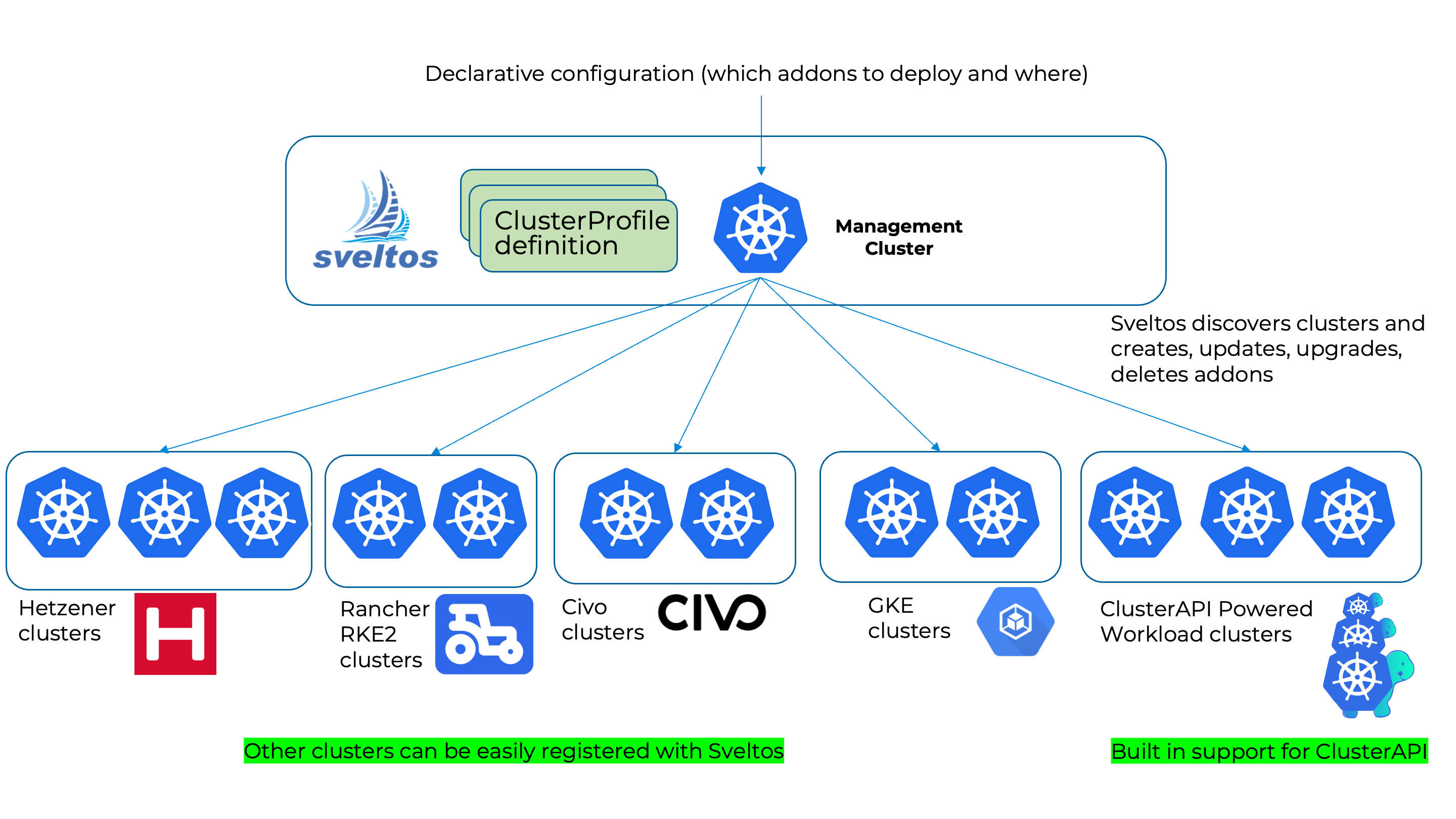
- Sveltos runs in a management cluster. It assists with the deployment and management of Kubernetes add-ons and applications. This works for any cluster in the fleet, including the management cluster.
- GitOps principles. We can use a GitOps controller to push configuration to the management cluster. Then, Sveltos takes over, distributing the desired state down the managed clusters.
- Sveltos supports a variety of add-on formats. This includes Helm charts, raw YAML/JSON, Kustomize, Carvel ytt, and Jsonnet. This flexibility allows us to manage add-ons using the format that best suits our needs.
- Sveltos provides powerful template capabilities and an event framework. This approach empowers us to better manage a fleet of clusters by customising deployments and reacting to cluster events.
Features
- 🔄 Orchestrated Deployment Order: Deploy resources in a defined order using simple Custom Resource Definitions (CRDs). Predictable, controlled rollouts.
- 👥 Multitenancy: Use
ClusterProfilefor fleet-wide policies andProfilefor namespace-scoped tenant isolation. - 🧩 Templating: Define add-ons and applications as templates; Sveltos instantiates them per cluster using cluster metadata.
- ⚡ Event-driven Framework: Trigger deployments from in-cluster or NATS events, with matching logic written in Lua or CEL.
- 📢 Observability: Notifications via Slack, Teams, Discord, Webex, Telegram, SMTP, or Kubernetes events.
- 🛡️ Pull Mode: Deploy into restricted environments: air-gapped, edge, or behind firewalls.
- 🚦 Progressive rollouts: Phased deployments from a single configuration; no need to maintain multiple profiles.
- 🧪 Job-based Checks: Run active probes like smoke tests, synthetic transactions, connectivity checks as Kubernetes
Jobsinside the managed clusters, using the Job outcome as the health verdict.
Sveltos is cloud-agnostic. It works across EKS, AKS, GKE, on-prem, and edge Kubernetes clusters. Define once, deploy everywhere regardless of the chosen provider.
Why Sveltos?
Sveltos was created to tackle the real challenges of managing multi-cluster add-ons. Sveltos complements GitOps controllers like ArgoCD and Flux by handling fleet-level orchestration and letting them continue to do what they do best.
Sveltos stands out for:
- Label-based fleet targeting: One configuration serves any matching cluster.
- Flexible drift detection (agent or agentless): Choose the mode that fits your environment.
- Per-cluster templating: Same definition, different values per cluster.
- Event framework and progressive rollouts: Safe, automated, and adaptable.
Sveltos for Edge Kubernetes
Running Kubernetes at the edge usually means a tight resource budget, limited CPU, memory, and bandwidth. Sveltos agents deployed in managed clusters are built for edge use cases. Sveltos deploys only what is actually needed.
What gets deployed and when
-
drift-detection-manager: Only shows up when a matching profile sets
syncMode: ContinuousWithDriftDetection. It watches only the resources that Sveltos itself deployed, nothing more. Footprint and resource consumption stay small. -
sveltos-agent: Handles event detection. If we have not defined any events to watch, it barely consumes resources. Even when watching resources, memory usage scales with what we ask Sveltos to observe. In a typical edge cluster setup, we will not have thousands of resources to watch. Even if we do, Sveltos will not act unless we specifically tell it to watch them.
-
sveltos-applier (Pull Mode): It polls the management cluster for new configurations to apply. That is all it does. Very light resource consumption.
Who's Using Sveltos?
See our adopters list. Using Sveltos in production? We'd love to add you.
Enterprise Offering
Need SLAs, professional services, or custom features? See our Enterprise Offering.
😻 Contributing to projectsveltos
We love to hear from you! We believe in the power of community and collaboration!
Your ideas and feedback are important to us. Whether you want to report a bug, suggest a new feature, or stay updated with our latest news, we are here for you.
- Open a bug/feature enhancement on GitHub
 .
. - Chat with us on Slack in the #projectsveltos channel
.
- If you prefer to reach out directly, just shoot us an email.
We are always thrilled to welcome new members to our community, and your contributions are always appreciated. Do not be shy - join us today and let's make Sveltos the best it can be! ❤️
Support the Project
If Sveltos saves you time, the single most helpful thing you can do is star the repo. It helps other engineers and the community to discover the project. Thank you for your support! 🙏