Resource Deployment Order - depends-on
Deploying resources and having them ready are two different things. Whether Sveltos deploys a Helm chart, a Kustomize overlay or a set of plain YAML manifests, the deployment is considered done as soon as the resources are created in the managed cluster. What they need to actually work may still be starting: for an add-on like cert-manager, its pods and webhooks. A ClusterProfile that depends on cert-manager can then deploy against something that is not ready yet, and fail.
Sveltos solves this with two fields:
dependsOnmakes a ClusterProfile wait for another ClusterProfile. Applications that need cert-manager can list a central cert-manager ClusterProfile independsOn, so it is deployed first.validateHealthsdefines what "ready" means for a ClusterProfile. Sveltos sets the ClusterProfile asprovisioned, and lets the ones depending on it proceed, only once all its health checks pass. Each check setsfeatureIDto say what it follows:Helmfor Helm charts,Kustomizefor Kustomize overlays, orResourcesfor plain YAML manifests.
There are four ways to define a health check:
| Check | What it evaluates | Use it when |
|---|---|---|
| Lua | A resource in the managed cluster | You need full scripting to decide if a resource is healthy |
| CEL | A resource in the managed cluster | A short expression is enough |
| Metrics | A Prometheus query | Health depends on live signals like an error rate |
| Job (Enterprise) | The outcome of a Kubernetes Job | You need an active probe like a smoke test |
The rest of this page goes through each check, using cert-manager as the running example, and ends with a ClusterProfile that depends on it.
Lua health validation
With Lua, Sveltos evaluates the evaluate() function against each resource selected by the validateHealths entry (available as obj), and the function returns whether the resource is healthy and a message explaining why not.
The below ClusterProfile will deploy cert-manager in any cluster matching the label selector env=fv and subsequently wait for all deployments in the cert-manager namespace to reach a healthy state (active replicas matching requested replicas) before setting the ClusterProfile as provisioned.
---
apiVersion: config.projectsveltos.io/v1beta1
kind: ClusterProfile
metadata:
  name: cert-manager
spec:
  clusterSelector:
    matchLabels:
      env: fv
  syncMode: Continuous
  helmCharts:
  - repositoryURL:    https://charts.jetstack.io
    repositoryName:   jetstack
    chartName:        jetstack/cert-manager
    chartVersion:     v1.13.2
    releaseName:      cert-manager
    releaseNamespace: cert-manager
    helmChartAction:  Install
    values: |
      installCRDs: true
  validateHealths:
  - name: deployment-health
    featureID: Helm
    group: "apps"
    version: "v1"
    kind: "Deployment"
    namespace: cert-manager
    script: |
      function evaluate()
        local hs = {healthy = false, message = "available replicas not matching requested replicas"}
        if obj.status and obj.status.availableReplicas ~= nil and obj.status.availableReplicas == obj.spec.replicas then
          hs.healthy = true
        end
        return hs
      end
CEL health validation
Alternatively, you can use Common Expression Language (CEL), which offers a more concise way to define the same health rule. The example below uses a CEL expression to check if the availableReplicas are equal to the requested replicas. The result is the same as the Lua script, providing a healthy and succinct way to validate the state of your deployments.
---
apiVersion: config.projectsveltos.io/v1beta1
kind: ClusterProfile
metadata:
  name: cert-manager
spec:
  clusterSelector:
    matchLabels:
      env: fv
  syncMode: Continuous
  helmCharts:
  - repositoryURL:    https://charts.jetstack.io
    repositoryName:   jetstack
    chartName:        jetstack/cert-manager
    chartVersion:     v1.13.2
    releaseName:      cert-manager
    releaseNamespace: cert-manager
    helmChartAction:  Install
    values: |
      installCRDs: true
  validateHealths:
  - name: deployment-health
    featureID: Helm
    group: "apps"
    version: "v1"
    kind: "Deployment"
    namespace: cert-manager
    evaluateCEL:
    - name: deployment_replicas
      rule: resource.status.availableReplicas == resource.spec.replicas
Metric-Based Health Validation
In addition to checking Kubernetes resource state, validateHealths entries can query a Prometheus-compatible metrics endpoint to gate deployment on live application signals. For example, Sveltos can confirm an error rate is below a threshold before considering a release healthy.
How it works
Add a metricSource field with the URL of the Prometheus endpoint, and one or more metricQueries. Each query is a named PromQL expression that must return a scalar value. Sveltos evaluates each query and exposes the results as a global metrics table inside the Lua evaluate() function. The key of each entry is the name given to the query.
validateHealths:
- name: error-rate-low
  featureID: Helm
  metricSource:
    url: http://prometheus-server.monitoring.svc:9090
  metricQueries:
  - name: errorRate
    query: >-
      sum(rate(http_requests_errors_total{namespace="my-app"}[5m]))
      /
      sum(rate(http_requests_total{namespace="my-app"}[5m]))
  script: |
    function evaluate()
      if metrics["errorRate"] > 0.05 then
        return {healthy = false, message = "error rate above 5%: " .. metrics["errorRate"]}
      end
      return {healthy = true, message = ""}
    end
The check above prevents Sveltos from marking the Helm feature as healthy until the error rate falls at or below 5 %. If the check fails, Sveltos retries according to the normal requeue interval. No deployment progress is marked until healthy = true is returned.
Push mode vs. pull mode
| Mode | Who queries the endpoint |
|---|---|
| Push | The addon-controller running in the management cluster. The metricSource.url must be reachable from the management cluster. |
| Pull | The sveltos-applier agent running inside the managed cluster. The URL is resolved via in-cluster DNS, so a cluster-local Prometheus service name (e.g. http://prometheus-server.monitoring.svc:9090) works without any external exposure. |
Combining metrics with resource checks
A single validateHealths entry supports only one evaluation path. To combine Kubernetes resource state with a metric check, add two entries under validateHealths: one using script or evaluateCEL against resource state, and one using metricSource + metricQueries. Both must pass before the feature is considered healthy.
Job-Based Health Validation
Part of the Enterprise offering — requires a valid Enterprise or Enterprise Plus license.
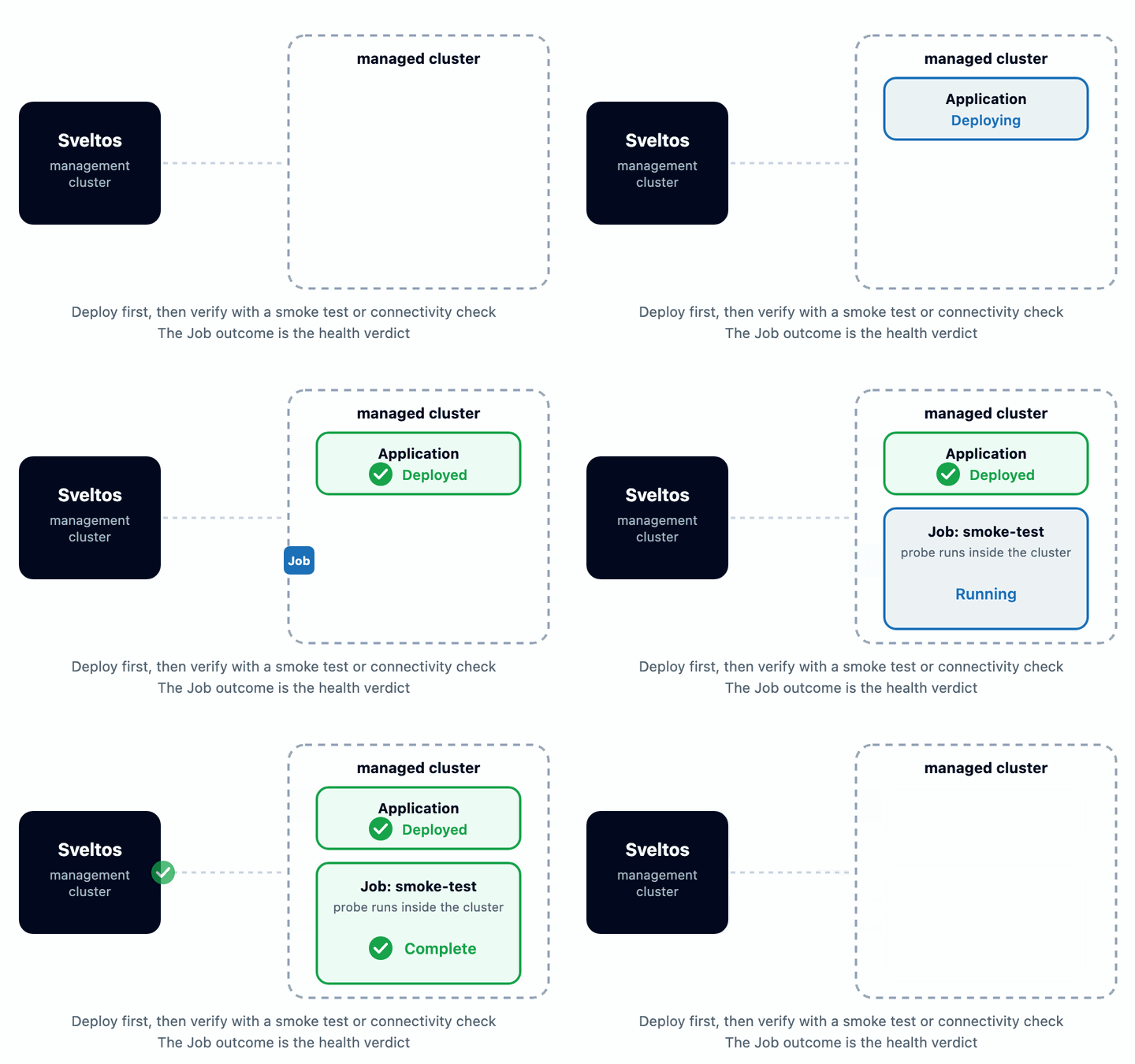
The Lua, CEL, and metric checks above all evaluate state that already exists in the managed cluster. jobCheck instead runs an active probe: Sveltos deploys a Kubernetes Job into the managed cluster and uses the Job's own Complete/Failed outcome as the check result. This is useful when the check itself needs to do something — a smoke test, a synthetic transaction, a connectivity probe from inside the cluster — rather than inspect a field.
How it works
Set jobCheck.jobRef to a ConfigMap or Secret containing the Job manifest. Sveltos deploys it into the managed cluster, waits for it to reach Complete or Failed (up to jobCheck.timeout, which defaults to 5 minutes when unset), then deletes it. On failure, the check's message comes from the Job's own status conditions.
apiVersion: v1
kind: ConfigMap
metadata:
  name: cert-manager-smoke-test
  namespace: cert-manager
data:
  job.yaml: |
    apiVersion: batch/v1
    kind: Job
    metadata:
      name: cert-manager-smoke-test
      namespace: cert-manager
    spec:
      backoffLimit: 0
      template:
        spec:
          restartPolicy: Never
          containers:
          - name: probe
            image: curlimages/curl:8.11.0
            command: ["curl", "-sf", "http://cert-manager-webhook.cert-manager.svc:443/healthz"]
---
validateHealths:
- name: cert-manager-smoke-test
  featureID: Helm
  jobCheck:
    jobRef:
      kind: ConfigMap
      namespace: cert-manager
      name: cert-manager-smoke-test
    timeout: 2m
jobCheck is mutually exclusive with script and evaluateCEL on the same validateHealths entry — a single entry runs either an active Job probe or a Lua/CEL evaluation, not both. To combine a Job probe with a resource or metric check, add separate entries under validateHealths, the same way described above for combining metrics with resource checks.
Putting it together: Nginx and cert-manager
In the below example, the ClusterProfile to deploy the nginx ingress depends on the cert-manager ClusterProfile defined above.
---
apiVersion: config.projectsveltos.io/v1beta1
kind: ClusterProfile
metadata:
  name: ingress-nginx
spec:
  clusterSelector:
    matchLabels:
      env: fv
  syncMode: Continuous
  helmCharts:
  - repositoryURL:    https://kubernetes.github.io/ingress-nginx
    repositoryName:   ingress-nginx
    chartName:        ingress-nginx/ingress-nginx
    chartVersion:     "4.8.4"
    releaseName:      ingress-nginx
    releaseNamespace: ingress-nginx
    helmChartAction:  Install
  dependsOn:
  - cert-manager