Resource Deployment Order
Introduction to dependsOn
ClusterProfile instances can leverage other ClusterProfiles to establish a deployment order for add-ons and applications. The dependsOn fields enables the definition of prerequisite ClusterProfiles. Within any managed cluster that matches the current ClusterProfile, the deployment of different add-ons and applications will start once all add-ons and applications in the specified dependency ClusterProfiles have been successfully deployed.
Example: Kyverno ClusterProfiles
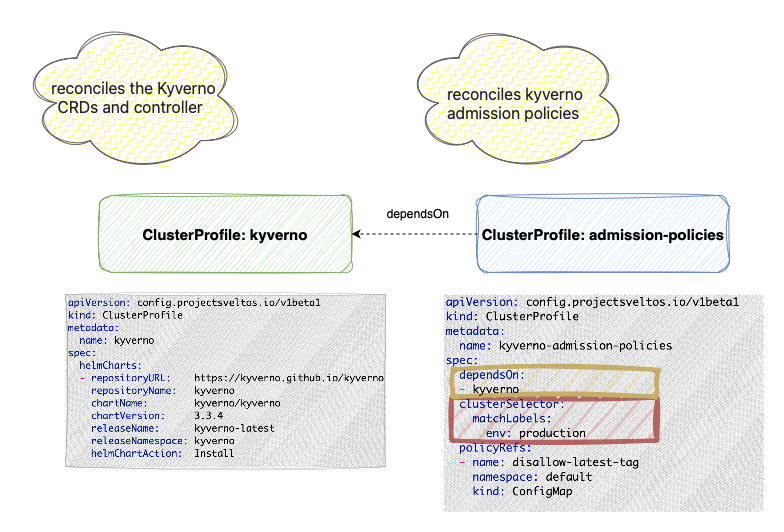
The below examaple displays a ClusterProfile which encapsulates all Kyverno policies for a cluster and declares a ClusterProfile dependency named kyverno, which is responsible for installing the Kyverno Helm chart.
---
  apiVersion: config.projectsveltos.io/v1beta1
  kind: ClusterProfile
  metadata:
    name: kyverno-admission-policies
  spec:
    clusterSelector:
      matchLabels:
        env: production
    dependsOn:
    - kyverno
    policyRefs:
    - kind: ConfigMap
      name: disallow-latest-tag
      namespace: default
    - kind: ConfigMap
      name: restrict-wildcard-verbs
      namespace: default
  ---
  apiVersion: config.projectsveltos.io/v1beta1
  kind: ClusterProfile
  metadata:
    name: kyverno
  spec:
    helmCharts:
    - chartName: kyverno/kyverno
      chartVersion: v3.3.3
      helmChartAction: Install
      releaseName: kyverno-latest
      releaseNamespace: kyverno
      repositoryName: kyverno
      repositoryURL: https://kyverno.github.io/kyverno/
Notice that the kyverno ClusterProfile lacks a clusterSelector, so it won't be deployed on its own. The kyverno-admission-policies ClusterProfile, however, has a clusterSelector targeting production clusters and a dependsOn field referencing kyverno. When this profile is created, Sveltos resolves its dependency. Any time a cluster matches the kyverno-admission-policies selector, Sveltos will first deploy the Kyverno Helm chart and then apply the admission policies.
Example: Kyverno and Kubevela ClusterProfile
In the below YAML definitions, the ClusterProfile instance cp-kubevela relies on the ClusterProfile instance cp-kyverno. That means that the cp-kyverno ClusterProfile add-ons will get deployed to clusters matching the label set to env=prod and afterwards, the ClusterProfile cp-kubevela will take place.
---
apiVersion: config.projectsveltos.io/v1beta1
kind: ClusterProfile
metadata:
  name: cp-kubevela
spec:
  dependsOn:
  - cp-kyverno
  clusterSelector:
    matchLabels:
      env: production
  syncMode: Continuous
  helmCharts:
  - repositoryURL: https://kubevela.github.io/charts
    repositoryName: kubevela
    chartName: kubevela/vela-core
    chartVersion: 1.9.6
    releaseName: kubevela-core-latest
    releaseNamespace: vela-system
    helmChartAction: Install
---
apiVersion: config.projectsveltos.io/v1beta1
kind: ClusterProfile
metadata:
  name: cp-kyverno
spec:
  clusterSelector:
    matchLabels:
      env: production
  helmCharts:
  - repositoryURL:    https://kyverno.github.io/kyverno/
    repositoryName:   kyverno
    chartName:        kyverno/kyverno
    chartVersion:     v3.3.3
    releaseName:      kyverno-latest
    releaseNamespace: kyverno
    helmChartAction:  Install
The above example is equivalent of creating a single ClusterProfile.
---
apiVersion: config.projectsveltos.io/v1beta1
kind: ClusterProfile
metadata:
  name: cp-kyverno
spec:
  clusterSelector:
    matchLabels:
      env: prod
  helmCharts:
  - repositoryURL:    https://kyverno.github.io/kyverno/
    repositoryName:   kyverno
    chartName:        kyverno/kyverno
    chartVersion:     v3.3.3
    releaseName:      kyverno-latest
    releaseNamespace: kyverno
    helmChartAction:  Install
  - repositoryURL:    https://kubevela.github.io/charts
    repositoryName:   kubevela
    chartName:        kubevela/vela-core
    chartVersion:     1.9.6
    releaseName:      kubevela-core-latest
    releaseNamespace: vela-system
    helmChartAction:  Install
Note
Separate ClusterProfiles promote better organization and maintainability, especially when different teams or individuals manage different ClusterProfiles.
Recursive Resolution
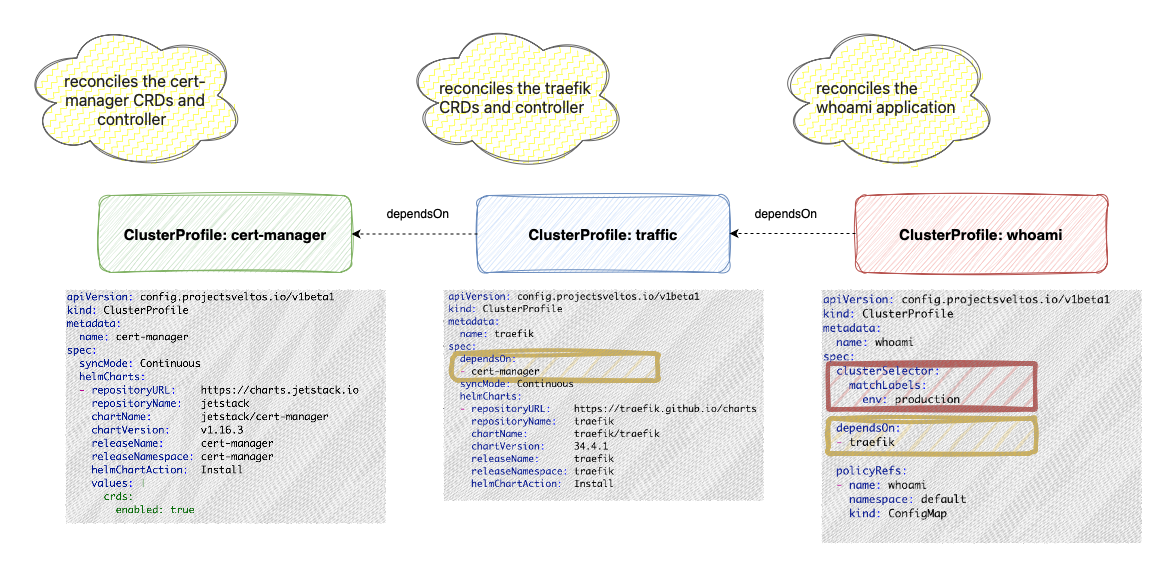
One of the key strengths of Sveltos is its ability to handle complex dependency chains. Imagine an application whoami that relies on Traefik, which itself depends on cert-manager. With Sveltos, you only need to define the deployment of whoami. Sveltos will automatically resolve the entire dependency tree, ensuring cert-manager and Traefik are deployed in the correct order before whoami is deployed. This simplifies complex deployments by automating the resolution of multi-level dependencies.
Dependency Deduplication
Sveltos efficiently manages shared dependencies by ensuring they are deployed only once per cluster, even when multiple profiles rely on them. This optimizes resource utilization and prevents redundant deployments. Crucially, Sveltos maintains a dependency as long as any profile requiring it is active on the cluster.
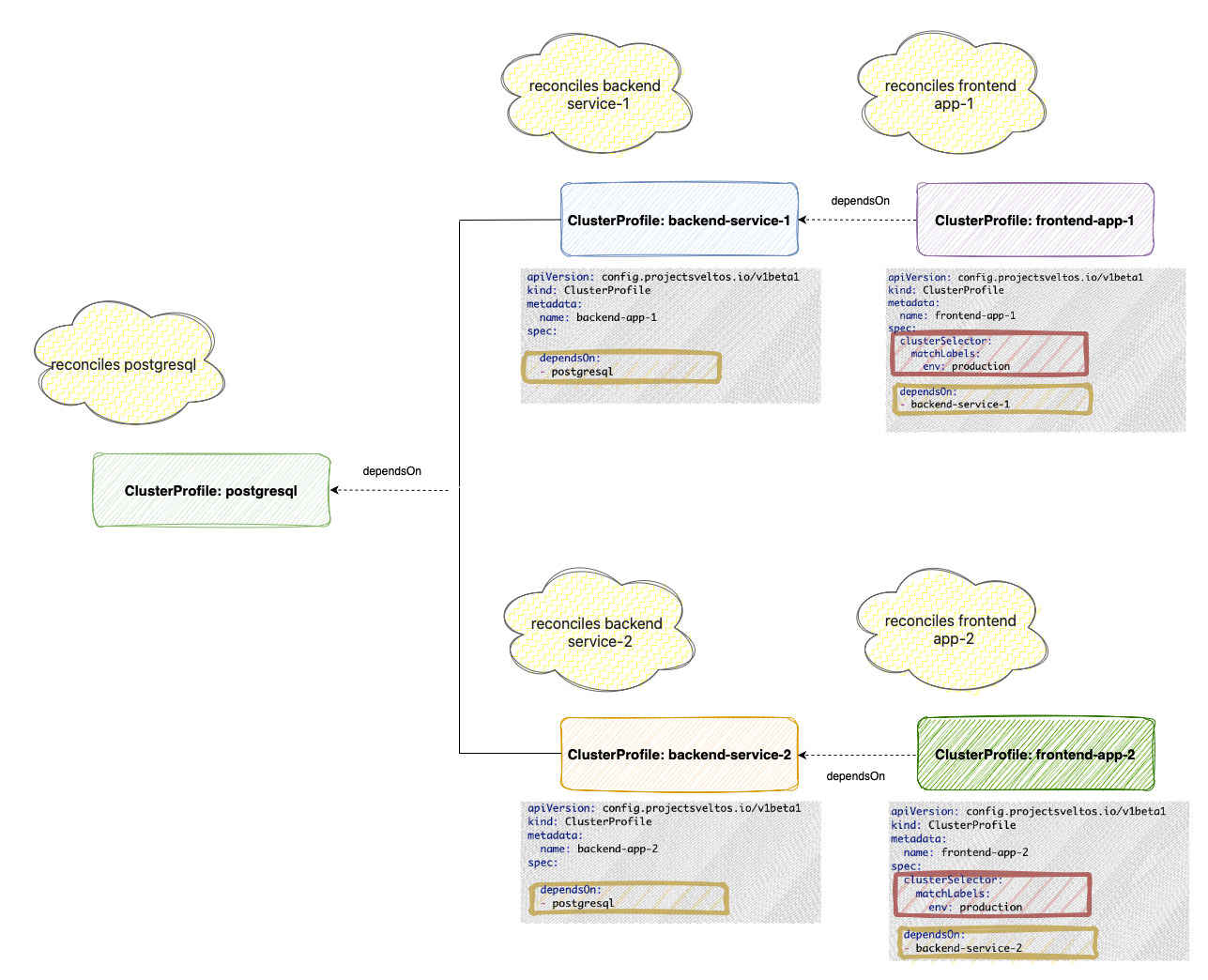
When frontend-app-1 is deployed, Sveltos first deploys postgresql and then backend-service-1, resolving the dependency chain. Subsequently, when frontend-app-2 is deployed to the same cluster, Sveltos recognizes that postgresql is already present and avoids redeploying it. If frontend-app-1 is then removed, backend-service-1 is also removed. However, postgresql persists because it remains a dependency of frontend-app-2. Finally, only when frontend-app-2 is removed will Sveltos remove backend-service-2 and postgresql, as they are no longer required by any active profile on the cluster.
Deletion Order
dependsOn is a two-way contract, the same pattern Kubernetes itself uses for a CRD with live custom resources, or a PVC still mounted by a pod: it doesn't just gate when a ClusterProfile is allowed to deploy, it also protects a prerequisite from being undeployed while a dependent still needs it.
Reusing the Kyverno example above, kyverno-admission-policies depends on kyverno. If both ClusterProfiles are deleted around the same time, Sveltos won't undeploy the Kyverno Helm chart while the admission policies ClusterSummary for that cluster still exists and still lists kyverno in its dependsOn, even though the two deletions were triggered independently and in no particular order. The kyverno ClusterSummary stays in Terminating, and its Status.Dependencies field reports what it's still waiting on. Once every dependent ClusterSummary for that cluster has been removed, kyverno's own undeploy proceeds.
This is separate from Dependency Deduplication above: deduplication decides whether a shared dependency still needs to be removed at all (only once nothing on the cluster requires it anymore); this deletion ordering decides the sequence dependents and prerequisites undeploy in, so a dependent's add-ons are always torn down before the prerequisite they rely on disappears out from under them.
-
To create the ConfigMaps with Kyverno policies used in this example
↩$ wget https://raw.githubusercontent.com/kyverno/policies/main/best-practices/disallow-latest-tag/disallow-latest-tag.yaml $ kubectl create configmap disallow-latest-tag --from-file disallow-latest-tag.yaml $ wget https://raw.githubusercontent.com/kyverno/policies/main/other/res/restrict-wildcard-verbs/restrict-wildcard-verbs.yaml $ kubectl create configmap restrict-wildcard-verbs --from-file restrict-wildcard-verbs.yaml